New Cabinet Entries
10/10/2026Hollywood Needs a Medical Consultant. I Volunteer.
I’ve thought for years that Hollywood ought to hire me as a medical consultant. Not because I have any particular desire to work in Hollywood, but because somebody needs to tell these people how badly they screw up medical scenes.
I’ve practiced medicine for over thirty years, including about fifteen years in emergency medicine, and I can’t seem to watch a medical scene in a movie or television show without shaking my head, laughing, or occasionally yelling at the screen.
Some of the mistakes are so ridiculous that I wonder whether anyone involved in making the show bothered to ask a medical professional how things actually work.
One of the earliest examples I remember was from a television show I watched years ago. I can’t remember the name of the show, but I’ve never forgotten the scene.
A patient was lying in an intensive care unit, apparently on life support. Behind the bed was a ventilator with its bellows visibly cycling up and down. Everything looked appropriately serious and dramatic.
Then the camera panned over to the patient.
He wasn’t intubated. He didn’t have a tracheostomy. He was lying there with a nasal cannula in his nose.
What the hell was that ventilator ventilating? The room?
I realize most people watching probably wouldn’t notice something like that. But I certainly did, and I remember laughing at how absurd it was.
Then there’s James Bond.
In Die Another Day, Pierce Brosnan’s Bond finds himself in a medical clinic where a North Korean operative is undergoing procedures to completely change his appearance.
The man is lying in a hospital bed with an IV running when Bond decides to interrogate him. Apparently, Bond has discovered a revolutionary new method of torture.
He grabs the IV bag and squeezes it.
The patient immediately sits up in agony, groaning and writhing. Bond squeezes the bag again, and the poor fellow suffers another wave of excruciating pain.
I remember thinking, “What the hell is he doing to him?”
He’s squeezing an IV bag. Unless there’s something particularly nasty in that bag, all he’s doing is making the fluid run a little faster. It’s not exactly an effective interrogation technique.
But the guy certainly seemed convinced.
Another one that has stuck with me came from Doogie Howser, M.D.
I once watched young Doogie receive a patient in the emergency department with a chest injury. He examined the patient, figured out what was wrong, inserted a chest tube, stabilized him, and had him transferred to the intensive care unit in what appeared to be about five or ten minutes.
Now, that’s impressive.
Not the medical care. The efficiency.
I’ve spent enough time in emergency departments to know that you can sometimes perform the lifesaving procedure faster than you can get everything else arranged.
Doogie managed the entire affair in less time than it sometimes takes to find somebody who knows where the chest tube tray is.
And then there’s Kill Bill.
Uma Thurman’s character has been shot in the head and spent years in a coma. When she finally wakes up, she discovers that she can’t move her legs.
Well, that’s not particularly surprising.
What happens next certainly is.
Through sheer determination, she manages to rehabilitate herself over the course of an afternoon. A little concentration, some toe wiggling, and before long she’s back in business.
Never mind the years of immobility. Never mind the muscle atrophy, contractures, weakness, and prolonged rehabilitation that would normally accompany that kind of situation.
Apparently, she’d just been taking a particularly long nap.
I know Kill Bill isn’t supposed to be a medical documentary. I don’t expect Quentin Tarantino to give me a detailed explanation of the consequences of prolonged immobilization. But Jesus Christ, the woman had supposedly been lying in a bed for years.
Recently, I discovered that I’m not the only person who has this problem.
I’m currently reading A Is for Arsenic: The Poisons of Agatha Christie by Kathryn Harkup. It’s a fascinating book that examines the poisons Christie used in her mysteries, how they affect the human body, and how accurately she portrayed their effects.
While discussing arsenic, Harkup made a comment that nearly caused me to spit out my drink. She admitted that she sometimes catches herself yelling at the television or movie screen when somebody gets the science of poisoning completely wrong.
I immediately recognized a kindred spirit.
Her particular complaint was the Hollywood tendency to have somebody swallow poison, grab their throat, gag dramatically, and fall over dead within seconds.
And she’s right. That’s not how most poisons work.
Different poisons have different mechanisms of action. Some produce symptoms rapidly, while others take hours or even days. Some cause neurological symptoms, others affect the heart, liver, kidneys, or gastrointestinal tract.
Unfortunately, watching somebody gradually develop abdominal cramps, vomiting, and diarrhea doesn’t make for particularly exciting television.
I understand that movies and television shows have to take liberties with reality. Nobody wants to watch a two-hour movie about waiting for laboratory results, arguing with an insurance company, or trying to find an available ICU bed.
I’ve done enough of that in real life.
But there’s a difference between taking a few liberties for the sake of entertainment and getting something so completely wrong that it becomes laughable.
And what irritates me most is how easily some of these mistakes could have been avoided.
Hollywood spends millions of dollars on costumes, sets, special effects, and historical details. They’ll hire experts to make sure somebody is holding the correct firearm or driving the appropriate automobile for the period.
But apparently nobody thought to ask whether squeezing an IV bag is a reasonable way to torture somebody.
Or whether a ventilator ought to be connected to the patient.
I’m not suggesting every medical scene needs to be completely accurate. I don’t expect a television show to spend forty-five minutes showing somebody putting in a chest tube and arranging an ICU admission.
But would it really be that difficult to ask somebody who knows what they’re doing?
Most of these mistakes could be corrected with a simple conversation. A physician, nurse, paramedic, or respiratory therapist could look at the scene and say, “Nope. That’s not how that works.”
And the scene would probably be better for it.
So, Hollywood, if you’re listening, I’m available.
I’ve spent thirty years practicing medicine, and I have absolutely no hesitation about telling somebody when they’re full of shit.
Although I suspect I’d get fired the first day.
Probably for laughing during a dramatic death scene. [...]Read more...

10/07/2026When Did I Become the Older Doctor?
Patients sometimes ask me an interesting question when I’m referring them to another physician.
“Is he an older doctor?”
I know what they mean. They aren’t really asking me how old he is. They want to know whether he has some age and experience on him, whether he has been doing this for a while, or whether he just got out of training.
It’s a perfectly reasonable question. The part I hadn’t really thought about until recently was this: When did I become the older doctor?
I graduated from medical school in 1995. I’ve been practicing medicine for more than thirty years. There really isn’t any creative way to do the math that still puts me in the young-doctor category.
I saw a T-shirt not long ago that made some joke about an older doctor, complete with the obligatory gray-haired old physician. I don’t remember exactly what it said, but I remember being mildly offended by it. Then it occurred to me that apparently I am now part of the demographic they were making fun of.
So how do I feel about being the older doctor?
I think I actually like it.
There is something reassuring about having thirty years behind you. I don’t feel like I have to prove that I know what I’m doing anymore. I’ve seen thousands of patients. I’ve made a lot of decisions, some of them easy and some of them very difficult. I’ve been right a lot of times. I’ve also been wrong, and sometimes you learn more from being wrong than you ever do from being right.
Experience matters in medicine.
That doesn’t mean the older doctor is necessarily the better doctor. There are some definite advantages to being young and recently out of training. A physician finishing residency today has learned things that didn’t exist when I was in medical school. Some of the medications, tests and treatments I routinely use today weren’t around in 1995.
A younger doctor may know something I don’t know. On the other hand, I may have seen something he hasn’t seen yet. There is value in both.
One thing that does happen after you’ve practiced medicine for a long time is that you become a little more skeptical about whatever the newest thing happens to be.
I’ve watched medications come onto the market with great fanfare and later disappear. I’ve seen treatments enthusiastically recommended and eventually abandoned. I’ve watched things that were considered standard medical practice become things we would never consider doing today.
After you’ve seen that happen enough times, the word “new” doesn’t impress you quite as much as it used to.
That doesn’t mean I’m against new medications or new treatments. Obviously medicine has advanced tremendously during my career, and I use plenty of things today that I couldn’t have used thirty years ago. A doctor who stops learning is going to become a bad doctor sooner or later.
But new doesn’t automatically mean better.
I’m perfectly happy using an older generic medication if it does the job. We know how it works. We know its side effects. We know most of the ways it can get us into trouble because millions of people have taken it over many years. It usually costs a fraction of what the newest medication costs, and most importantly, it still works.
I don’t feel any particular obligation to abandon something that works just because a pharmaceutical company has something newer to sell me.
Maybe that is part of being the older doctor too.
The other part is realizing that medicine doesn’t work exactly the way the textbooks say it does.
Patients certainly don’t.
People have financial problems, family problems, transportation problems and bad habits. They don’t always take their medicine. They don’t always follow your advice. Sometimes they can’t afford to follow your advice. Diseases don’t always present the way they are supposed to, either.
After thirty years, you learn to practice medicine in the world that actually exists instead of the one described in a textbook.
I think that may be the biggest difference between the doctor I was in 1995 and the doctor I am today.
When I was younger, I had a tremendous amount of freshly learned medical knowledge and not much experience actually being a doctor. Thirty years later, I’m sure I’ve forgotten things I once knew, and there are certainly things younger physicians know better than I do. That’s why I keep learning.
There is another part of experience that is harder to put into words.
Years ago, either in medical school or residency—I honestly don’t remember which—I did a rotation with a very good, well-known pediatrician in Evansville, Indiana. He would send me into the room first to see the patient, then I would come back out and present the case to him.
At some point during that rotation he told me something I’ve remembered ever since. He said I had a relatively rare ability to look at a patient and tell whether that patient was sick or wasn’t sick.
I took that as a tremendous compliment, especially coming from him.
I understood what he meant then, but I understand it much better now.
Sometimes a patient walks into the room and something just doesn’t look right. The vital signs may not be particularly alarming. I may not have finished the history yet. Sometimes I can’t immediately tell you exactly what is bothering me. I just know this person is sick.
That’s not magic, and it certainly isn’t infallible. Some of it may be instinct, but after thirty years there is also an enormous catalog of patients stored somewhere in the back of my head. The person sitting in front of me is being compared, consciously or not, with thousands of other people I’ve examined over the years.
That pediatrician thought I had some of that ability when I was still learning how to be a doctor. Thirty years of seeing patients has given it a lot more material to work with.
You don’t learn that from a PowerPoint presentation. You learn it by seeing patients over and over again for years.
So I guess I have my answer. I am the older doctor now, and I’m actually pretty comfortable with that.
It doesn’t mean I know everything, because I certainly don’t. It doesn’t mean I’m always right. And it absolutely doesn’t mean I should still be practicing medicine exactly the way I did when I graduated in 1995.
It just means I’ve been doing this long enough to have seen medicine change, sometimes for the better and occasionally back again. I’ve watched wonder drugs become ordinary drugs and a few become drugs we no longer use at all. I’ve learned that patients will surprise you, diseases will fool you, and being absolutely certain about anything in medicine can be dangerous.
The younger doctor has the advantage of the newest education medicine can provide.
The older doctor has something that takes a little longer to acquire.
He’s been around long enough to see what happens next. [...]Read more...
10/06/2026The Heresies We Now Call Medicine
One of the things I find fascinating about the history of medicine is how often today’s obvious truth was yesterday’s ridiculous idea.
For centuries, physicians had perfectly respectable explanations for disease. There were the four humors—blood, phlegm, yellow bile, and black bile—and illness could result when they fell out of balance. Later, miasma theory blamed disease on foul or corrupted air. If a neighborhood smelled terrible and everyone there was getting sick, blaming the smell wasn’t an unreasonable conclusion. They could see the association. They just couldn’t see the bacteria.
The problem wasn’t that these physicians were stupid. They were practicing medicine using the best framework they had. The problem came when the framework became so firmly established that evidence contradicting it became harder to accept than the disease itself.
And occasionally somebody came along who noticed something that didn’t fit.
In the nineteenth century, physicians could go from an autopsy or dissection to examining patients, delivering babies, or performing procedures without anything resembling modern hand hygiene. A blood-stained surgical coat wasn’t necessarily regarded as disgusting. It could be almost a badge of experience—a visible sign that its owner was a busy surgeon.
Then physicians began noticing uncomfortable patterns.
Ignaz Semmelweis famously recognized that women delivered in the physicians’ maternity ward were dying of puerperal fever at a far higher rate than women delivered by midwives. The physicians and medical students, however, had a habit the midwives didn’t: they performed autopsies. They could leave the autopsy room after working with a decomposing corpse and go directly upstairs to examine a woman in labor.
Semmelweis didn’t know about bacteria. Nobody did. But he became convinced that the doctors were carrying something on their hands—what he called “cadaverous particles”—from the dead bodies to their living patients. He required them to wash their hands in a chlorinated lime solution before examining women, and the mortality rate plummeted.
You would think that would have settled the argument.
It didn’t.
The suggestion that physicians themselves were killing their patients was insulting. Semmelweis was ridiculed, professionally ostracized, and increasingly isolated. Over the years he became angry, erratic, and mentally ill. In 1865, at only 47 years old, he was committed to an asylum in Vienna. Within weeks he was dead.
There is some uncertainty about exactly what caused his mental deterioration and even about the circumstances surrounding his final illness, so it would be going too far to say that the medical establishment literally “drove him insane.” But there is no question that his professional rejection and increasingly bitter battles with his colleagues dominated the final years of his life.
The particularly cruel part of the story is that Semmelweis was essentially correct about the important thing. Doctors were carrying disease from the autopsy room to the maternity ward, and washing their hands was saving women’s lives.
He just couldn’t yet tell them why.
A little later, Joseph Lister took things much further. Lister had something Semmelweis hadn’t had: the work of Louis Pasteur. Pasteur’s experiments were providing evidence that fermentation and putrefaction weren’t spontaneous events. Microscopic organisms were involved.
Lister began wondering whether the same principle applied to surgical wounds.
His early antiseptic methods using carbolic acid would look primitive—and sometimes downright unpleasant—to us now. But the underlying idea was revolutionary: perhaps postoperative infection wasn’t an inevitable consequence of surgery. Perhaps something from the outside was getting into the wound, and perhaps the surgeon could prevent it.
That sounds painfully obvious today.
It wasn’t then.
Medicine went through another upheaval at about the same time over something equally fundamental: pain.
Before reliable surgical anesthesia, surgery wasn’t merely dangerous. It was an ordeal. Speed was one of the surgeon’s greatest skills because the patient was conscious, terrified, and very much capable of moving. Assistants weren’t merely handing instruments to the surgeon. Sometimes their job was to hold the patient down.
Surgeons such as Thomas Dent Mütter were pushing the boundaries of reconstructive surgery in that world. Then ether and chloroform arrived in the 1840s and changed what surgery could be.
And even anesthesia had opponents.
One of the more interesting was Philadelphia obstetrician Charles D. Meigs. He resisted anesthesia in childbirth and represented a school of thought that regarded labor pain as natural and therefore something that should not necessarily be abolished. Other objections to anesthesia were religious, philosophical, or simply based on the very legitimate fact that early anesthesia could itself kill you.
Again, from our perspective the argument seems almost bizarre.
Imagine telling a patient today:
“We’re going to amputate your leg. Four large men are going to hold you down while I do it because anesthesia seems unnatural.”
You wouldn’t call that traditional medicine. You’d call the police.
And that’s what makes medical history so interesting to me.
It isn’t simply a progression from stupid people to smart people. The people defending the old ideas were often intelligent, educated, accomplished physicians. Many genuinely believed they were protecting their patients from dangerous new theories.
They simply happened to be wrong.
Semmelweis couldn’t see the organism being carried from the autopsy room. Lister couldn’t watch bacteria enter a surgical wound with his naked eye. The first physicians using ether couldn’t provide generations of safety data proving that anesthesia was preferable to having several men pin a screaming patient to an operating table.
Someone had to look at what was actually happening and say:
Maybe what we’ve always believed isn’t right.
Eventually the heresy became evidence.
The blood-soaked surgical coat became a contamination hazard instead of a badge of honor. Hand washing became routine. Antisepsis became asepsis. Anesthesia went from controversial experiment to an entire medical specialty. Germ theory displaced explanations involving bad air and unbalanced humors.
And perhaps that’s the most useful lesson buried in all of this.
Medicine has never reached a point where everyone suddenly knew everything. It has moved forward because somebody noticed that the accepted explanation didn’t quite fit the evidence—and was stubborn enough to keep asking why.
Some of those people were ridiculed.
Some were ignored.
Some lived long enough to be vindicated.
And every once in a while, yesterday’s medical heresy becomes something so ordinary that we can hardly imagine anyone ever arguing against it. [...]Read more...

06/24/2026Title
Paskola – A Flesh Forming Food
Author
The Pre-Digested Food Company, New York
Image
Description
Paskola was a late nineteenth-century nutritional preparation marketed as a “Flesh Forming Food” for individuals suffering from thinness, malnutrition, digestive weakness, and chronic wasting diseases. Advertisements claimed the product was “artificially digested,” allowing weakened patients to absorb nourishment with little digestive effort. The preparation was promoted as superior to cod liver oil and was intended for invalids, convalescents, tuberculosis sufferers, and those unable to maintain weight.
This example is an exceptional survivor, retaining its original foil seal, substantial portions of the original paper label, neck directions label, embossed pineapple trademark, embossed company name, and apparent original contents. The bottle is embossed “Paskola” and “The Pre-Digested Food Co.” and represents an important example of Victorian nutritional therapeutics during the era when physicians and patent medicine manufacturers alike sought ways to combat wasting diseases through concentrated nourishment.
Condition
Original amber embossed bottle retaining original foil seal, partial front label, neck directions label fragments, and apparent original contents. Label exhibits expected losses, edge wear, and deterioration from age. Embossing remains sharp and highly legible. No major chips or cracks visible. Outstanding display value due to survival of original labels and seal, which are seldom encountered together.
Gallery
Historical context
During the late nineteenth century, weight loss and “wasting diseases” were major medical concerns. Tuberculosis, chronic infections, digestive disorders, and malnutrition frequently left patients weak and emaciated. Products such as Paskola were developed to provide concentrated nutrition that was supposedly easier to digest than ordinary food. The product was advertised as an artificially digested preparation that could help build flesh and restore strength without taxing the digestive system. Such remedies occupied the blurred boundary between legitimate nutritional science and patent medicine marketing during the Victorian era.
Curious Facts, Ephemera, and Trivia
Paskola was advertised as “superseding cod liver oil,” one of the most common nutritional remedies of the nineteenth century.
The embossed pineapple served as the company’s trademark and likely referenced digestive enzymes associated with pineapple.
The bottle directions instructed users to mix the preparation with water and consume it with meals.
The company emphasized that patients could “eat anything the stomach craves,” reflecting contemporary beliefs about predigested foods.
Original sealed examples with surviving labels are significantly scarcer than empty embossed bottles.
Products such as Paskola anticipated the later development of liquid nutritional supplements and medical foods.
Excerpt
“Paskola – A Flesh Forming Food (Artificially Digested) for Thin, Pale People and All Wasting Diseases. Superseding Cod Liver Oil.”
Why it is in the Cabinet
This bottle represents the fascinating intersection of nutrition, digestive science, tuberculosis treatment, and patent medicine advertising during the Victorian period. The survival of the original seal, contents, label, and embossed glass transforms it from a simple medicine bottle into a remarkably complete artifact that demonstrates how late nineteenth-century Americans attempted to address malnutrition and chronic illness. It is an excellent example of the era’s belief that scientific food preparations could rebuild the body and restore health.
← Back to the Cabinet Directory
Support Dr. Bebout’s Cabinet of Medical Curiosities
If you enjoy the history, the oddities, and the effort, help keep this cabinet open. Every little bit helps preserve and share the strange wonders of medicine’s past.
Buy Me a Ko-fi ☕
Buy Me a Coffee ☕
Tip via PayPal 💵 [...]Read more...
06/22/2026Title
Kemp’s Balsam Advertising Trade Card
Author
Orator F. Woodward
Image
Description
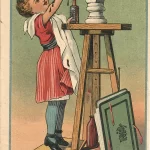
This original circa 1902 Victorian advertising trade card promotes Kemp’s Balsam, one of America’s best-known patent cough medicines. The colorful front illustration depicts a child holding a bottle of Kemp’s Balsam beneath the humorous slogan “Open Oo’Mouf and take Kemp’s Balsam.”
The reverse contains a second advertisement for Lane’s Family Medicine, an herbal laxative marketed as “Lane’s Tea,” illustrating the common practice of printing multiple medical advertisements on a single trade card.
Trade cards like this were distributed free by pharmacists and merchants and were often collected into family scrapbooks, making them among the most colorful survivors of nineteenth-century pharmaceutical advertising.
Condition
Very Good.
Minor edge and corner wear consistent with age. Bright colors, clean surfaces, complete front and reverse with no significant losses.
Gallery
Historical context
During the late nineteenth and early twentieth centuries, trade cards became one of the primary forms of pharmaceutical advertising. Long before radio and television, colorful lithographed cards encouraged brand recognition while making medicines appear friendly and trustworthy.
Kemp’s Balsam claimed to relieve coughs, colds, bronchitis, croup, asthma, and even consumption, while Lane’s Family Medicine promised gentle relief from constipation through herbal ingredients. Both products relied heavily on persuasive advertising rather than scientific evidence.
Curious Facts, Ephemera, and Trivia
Trade cards were often collected in albums rather than discarded.
Many pharmaceutical companies hired professional artists to create memorable illustrations.
The intentionally misspelled phrase “Open Oo’Mouf” was designed to make the advertisement humorous and memorable.
Dual-sided advertisements reduced printing costs while promoting multiple products.
Excerpt
“Open Oo’Mouf and take Kemp’s Balsam.”
One of the more memorable slogans from American patent medicine advertising.
Why it is in the Cabinet
Medical advertising often tells us more about public perception than the medicines themselves. This trade card captures the optimism, artistic style, and marketing ingenuity of the patent medicine era, making it an excellent example of pharmaceutical ephemera.
← Back to the Cabinet Directory
Support Dr. Bebout’s Cabinet of Medical Curiosities
If you enjoy the history, the oddities, and the effort, help keep this cabinet open. Every little bit helps preserve and share the strange wonders of medicine’s past.
Buy Me a Ko-fi ☕
Buy Me a Coffee ☕
Tip via PayPal 💵 [...]Read more...
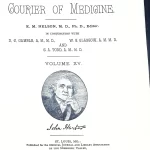
06/19/2026Title
St. Louis Courier of Medicine. Volume XV, No. 6. June 1886.
Author
Edited by E. M. Nelson, M.D., Ph.D.
Image
Description
This June 1886 issue of the St. Louis Courier of Medicine is a strong example of a late nineteenth-century American medical journal. It includes original articles, case reports, editorials, book reviews, society proceedings, medical advertisements, and notices aimed at practicing physicians.
The issue is especially useful because it captures medicine during a period of major transition. Physicians were still using many older therapies and clinical traditions, but germ theory, antiseptic surgery, bacteriology, medical specialization, and pharmaceutical advertising were rapidly reshaping practice. Notable content includes the editorial “The Malarial Germ,” an advertisement for an Atlas of Venereal Diseases, full-page pharmaceutical advertising from Rio Chemical Company, and a Missouri Medical College advertisement documenting medical education in the 1880s.
Condition
Original period medical journal pages with expected age toning and wear. Text and advertisements remain readable and suitable for research, display, and archival documentation.
Gallery
Historical context
By 1886 American medicine was moving away from older explanatory models of disease and toward laboratory-based medicine. Medical journals like this one helped physicians keep up with new theories, treatments, instruments, books, schools, and drugs. This issue is especially interesting because it shows germ theory entering ordinary professional discussion while traditional therapeutics and aggressive pharmaceutical advertising remained very much alive.
Curious Facts, Ephemera, and Trivia
The issue includes an eye-catching advertisement for an Atlas of Venereal Diseases, showing how specialized illustrated atlases were marketed directly to physicians.
“The Malarial Germ” editorial reflects the medical profession working through the new microbial explanation of malaria.
The Rio Chemical Company advertisement promotes several proprietary preparations, including Celerina, Aletris Cordial, Acid Mannate, and Pinus Canadensis.
The St. Louis Medical College advertisement gives a period look at medical training, faculty, and institutional promotion.
This issue functions as both a medical journal and a physician’s shopping guide.
Excerpt
“The Malarial Germ”
This editorial is a useful glimpse into physicians debating disease causation during the rise of bacteriology and parasitology. It shows medicine in motion—not fully modern yet, but no longer comfortably old-fashioned either.
Why it is in the Cabinet
This issue belongs in the Cabinet because it documents what physicians were reading, buying, debating, and teaching in 1886. It connects several Cabinet themes at once: infectious disease, medical publishing, pharmaceutical advertising, venereal disease, medical education, and the transition toward modern scientific medicine.
Digital Copy
A complete, high-resolution digital copy of this journal is available through the Internet Archive and may be viewed online or downloaded free of charge.
Download: https://archive.org/details/st.-louis-courier-of-medicine-06-1886
← Back to the Cabinet Directory
Support Dr. Bebout’s Cabinet of Medical Curiosities
If you enjoy the history, the oddities, and the effort, help keep this cabinet open. Every little bit helps preserve and share the strange wonders of medicine’s past.
Buy Me a Ko-fi ☕
Buy Me a Coffee ☕
Tip via PayPal 💵 [...]Read more...